Monday, January 12, 2015

Bird feeding - FRUIT


EASY WINTER BIRD FEEDING: FRUIT
 

A female Cardinal considered dull compared to her bright red mate is a welcomed guest in my winter garden.
Mockingbirds, Cardinals and Purple Finches are a few of our local back yard birds that eat fruit. A planting of fruiting trees and shrubs is a sure way to bring these and many other beautiful migrating birds into our gardens. Most birds follow these fruiting trees and flowers as they migrate south in the winter months.
For the birds that don't migrate, fruit in winter is impossible to find but still greatly appreciated if you can supply it.


Best known for it's mating song on summer nights, Mockingbirds
will become daily visitors if you put apples in your garden for them.
 Apples, grapes, raisins are the best choice for winter bird feeding.*

Raisins are the easiest fruit to supply. Just put a few in the same area each day and your birds will make a daily visit to that area.

If you have extra apples, rather than putting them in the trash feed them to birds. Apples store for a long period of time so keep them in your crisper until you want them. They don't have to be perfect. Over-ripe apples with a few brown spots are fine. Birds aren't picky. Simply cut off the top or slice them if you prefer. You can toss them out the door but I put them on a spike where I have a good view from my window.


Purple finches are attracted to fruit and many types of seeds.
If you have a lot of extra grapes put some in the freezer until you need them. I only put out three of four grapes a day. You can also serve blueberries or cranberries if available.
I try to avoid waste that can attract unwanted visitors at night, such as mice.

Don't be surprised to see a beautiful Mockingbird in your garden every winter day enjoying an apple or a few grapes.


I prefer to slice off the top of the apple and place it on the ground. 
Birds will have two options to feed and easier access. 
*Our local birds do not eat oranges, bananas and other tropical fruit so don't put them out.

Enjoy your garden all year long, 
James

Tuesday, December 23, 2014

Houseplants as gifts


HOUSEPLANTS AS GIFTS

If you are searching for a houseplant to give as a gift this season you can't go wrong with a 'croton'.


Crotons (Codiaeum) have very colorful leaves which can brighten any winter day. With basic care these colorful  houseplants will easily survive for years in a sunny window.  A few hours of sunlight is the key to maintaining the best color on the leaves.  Red, yellow, pink and green are often on the same leaf with no two leaves identical.

When giving a houseplant as a gift it is important to consider its new home.  If the recipient often says "I kill every plant I get" give them a plant that is easy to care for such as a Christmas cactus (Schlumbergera).  Blooming during the holiday season these tropical plants are very easy to keep alive. The key to bringing this plant into flower every year is natural sunlight. As the days get shorter it triggers these plants to develop their flowers.

Proper care and natural sunlight are all  the Christmas cactus require to trigger its annual bloom cycle.

Orchids and Poinsettia, both popular gifts are very sensitive to drafts and temperature fluctuations.


The decorative foil on this poinsettia will not permit water to drain away. Sadly this is a major cause of  death of this popular flowering plant. Remove the foil and put the pot in the sink while watering. After it has drained, it is safe to put the foil back on. Let the soil slightly dry out before watering again.


It is important to get your plant home from the shop without damaging it. Cover the plant with plastic or a paper bag, then move it from the store to a warm spot in your car, not the cold car trunk. Once home remove it immediately from the wrapping (which will now hold the cold)  and check the soil for moisture. When taking your gifts to their new home repeat the process.


Orchids make wonderful gifts. Now with modern propagation techniques they are more affordable
and popular than ever.

 This care will prevent your orchids from dropping unopened blooms or your poinsettia from wilting away in just a few days.  If the cashier is busy, step to the side and properly  cover the plants before leaving the store.

After being hit by a blast of cold air these orchids blossoms are wilting
and will drop off before opening.

Finally find the care instructions for your plant in a book or on the internet, make a copy and give this with the plant.  It will help answer any questions, ensure proper care and give the plant a better chance for survival.

Merry Holidays,
James


Saturday, November 29, 2014

Winter Bird Feeding- Gleaning


EASY WINTER BIRD FEEDING: GLEANING


Cardinals are attracted to gray striped and black-oil sunflower seeds  
 
Many people would like to help feed birds during the winter but for various reasons do not want to get involved with tending bird feeders.  When the ground is frozen or covered with snow there is a simple technique you will appreciate and birds will love. Simply sprinkle seed on the ground.
 
White Crowned Sparrows prefer millet, black-oil sunflower seeds & peanut hearts

Gleaning is a type of foraging during which a bird will deliberately and methodically pick over an area to collect food; typically insects or seeds.  Many species that overwinter in our area use this method of feeding for at least part of their diet.  Dark-eyed Juncos, White-crowned sparrows, Mourning Doves and even Cardinals will frequent your garden to glean seeds off the ground.


Mourning Doves love Millet and Black-oil sunflower seeds 
 
The best seed for this type of feeding are black oil sunflower seeds or finch mix, without corn. The popular wild bird mixes contain a lot of corn which attracts many larger aggressive birds such as Starlings and Grackles which will chase your smaller, and more colorful birds away. 

Dark-eyed and Slate-colored Junco's like many types of seeds and products like pie crust.

Keep it as simple as possible. Scatter a cup or two of seed in the same area and birds will come back when they need to. I don't sprinkle too much at once because I don't want unnecessary and expensive waste. That will also help avoid left overs at night which will attract mice.


Give your birds an escape route from hawks and other predators
If you have an easily assessable area with a view from a window, that is perfect. Even if you are a devoted back yard bird watcher, tossing some seed on the ground will give your feathered friends more of a choice of areas in which to feed.


Enjoy your garden all year all.
James

Thursday, October 30, 2014

Lady beetles


HOME INVADERS #1
LADYBUGS


All of us have childhood memories of catching ladybugs, letting them crawl up our arms and then releasing them; often with the flick of a finger to watch them fly away.


During the autumn, lady beetles crawl to overwintering sites where a few to several hundred will gather in an 'aggregation' (gathering together into a dense mass). The aggregation site might be located at the base of a tree, along a fence, or under a rock. Beetles are usually found under leaves which protect them from cold winter temperatures.


Sometimes lady beetles can become a nuisance to humans. Some congregate in large numbers on the sunny side of the house. Occasionally  they invade homes in huge numbers. Since lady beetles are beneficial, insecticide treatments are not suggested. Physically remove lady beetles by using a clean vacuum bag and then release them out doors at the base of a tree or shrub. Caulk and seal spaces and gaps around your house to prevent them from coming inside again.


Ladybugs are considered beneficial because they eat large numbers of insects which do damage to plants, flowers and food crops. Among these pests are aphids, soft scales, mealy bugs and spider mites. Ladybugs do not  harm humans or our pets in any way. Most people consider them pretty little creatures.


Although they look nothing like the adults, ladybugs nymphs do a fantastic job of keeping your garden free of many destructive insects.  You may spot them in your yard in late spring and during the  summer.


Happy Gardening,
James


Friday, October 10, 2014

Planting Spring Flowering Blubs


IT'S TIME TO PLANT SPRING FLOWERING BLUBS

A glorious bed of spring bulbs brightens the garden like little else can; well worth the time and energy you put into it now.


Leading the pack are the showstoppers, *tulips and daffodils, followed by a long list of spectacular flowers: crocus, snowdrops, muscari and allium to name a few. By planting clusters of different blubs around your garden you will enjoy flowers for many weeks.

Daffodils and tulips have hybrids that bloom at slightly different times: early, mid or late spring. The time is listed on the package or in the catalog. You can easily prolong the blooming period by planting some of all three.  For nice punches of color avoid blending all three together. For example, I plant separate clusters, 13 early bloomers, then a splash of  19 late and a bed of 17 mid-blooming bulbs. As the first bed fades away, eyes are drawn to the mid and then the late blooming bulbs.  Another "technique used by the Japanese",  is to plant odd numbers of bulbs. It flows more naturally on the eye. Landscapers do this with everything from flowers to shrubs.


Tulips and daffodils are planted 6 to 8 inches deep. As you are filling  the holes consider planting smaller flowers such as crocus over them around 2 or 3 inches, thereby including an earlier spring display in the same place with the same amount of work.


As with all flowers planting correctly will extend your display for years. Add a handful of chopped leaves at the bottom of the hole and sprinkle in some bone meal for a strong root system.  


Should you water after planting blubs? YES.  Watering your blubs encourages them establish roots before the ground freezes. This will give your plants a strong head start when the ground warms up in early spring.


If you love to herald the end of winter, plant snowdrops by your front door. A small simple white flower, snowdrops are the first to bloom in the spring. They even  go dormant if it snows and then bounce back as good as new. The snowdrop blubs I planted twenty years ago still bloom strong every March. I love that.


*Tulips have been an all time favorite since the days of 'Tulipmania' which peaked in the 1630's. Tulips have two drawbacks. First is that they can only be depended on for a few years before they begin to dwindle away and need replanting. To make this easier do not plant smaller blubs over them and keep tulips in an area all their own. Secondly,  many critters think tulips taste as good as they look.


Keep them behind fencing and away from deer if possible. Squirrels, groundhogs and rabbits also line up at your 'tulip salad bar'.  None of the animals listed above snack on daffodils or the later blooming allium.

 Happy Gardening,
James

Tuesday, September 23, 2014

Chrysanthemums


CHRYSANTHEMUMS


Originally from China and cultivated for centauries in Japan, chrysanthemums remain a very popular autumn flower. Commonly called mums, these delightful plants can be easily found at your *local garden centers as well as grocery and even hardware stores.

Mums are available in many colors from white, pink and purples to my favorites the yellow and gold and orange.  I love the way they blend with changing hues of the trees.  There are even varieties with multi-colored flowers. Whichever color you choose you will be rewarded with weeks of additional color in your garden.


Like all flowering plants, mums need a good amount of water to stay healthy; more than most. If planted in the ground they need water every other day. In pots on your front steps they do best if watered every day. If you can store a gallon of water within arm’s reach, this task will be much easier.  The easier I can make a job the more likely I am to do it. The Japanese claim the success to great flowering mums is watering twice a day; once in morning and then again in the late afternoon. The popular soilless potting mixtures dry out incredibly fast.


If the winter is mild mums can come back for years. This is not dependable and is a major reason why chrysanthemums are so inexpensive compared to other garden perennials. They are generally considered an annual.


At the end of the season cut your mums down to the ground and cover them with mulch, in the spring pull the mulch away to see if your plants have survived. If they have come back, give them a good feeding and cut back at least twice, late spring and mid-summer to encourage them to become bushy. Bushy mums will produce many more flower heads. You will have better luck if you plant young mums in the spring so they have a few months to adjust and root in.

*Although you can easily buy mums everywhere, our local garden centers offer the best selection of plants maintained with the finest care. Garden Centers depend on this seasonal business. Please support them.

 
Happy Gardening,
James


Sunday, July 27, 2014

Hummingbird feeders


ATTRACTING HUMMINGBIRDS


Hummingbirds have amazed humans for thousands of years, darting though the air so fast it's hard to spot them before they disappear. Now with hummingbird feeders it is easier than ever to attract these delightful birds into our own gardens.


Following the flowers as they bloom though the seasons, hummingbirds journey from Central America as far north as Alaska and Canada every year. Acrobats of the air, they are able to hover and stop in midair as they scout out the environment. Feeding five to eight times an hour, it isn't long before they are off in search of fresh flowers and their next meal. Hummingbirds have the greatest energy output, gram for gram, of any known warm-blooded animal.

 
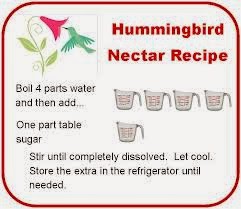
The recipe for the syrup is simple. Bring one cup sugar and four cups spring water to a boil for one minute. Let it cool to room temp before filling feeders and store extra nectar in the refrigerator. Keep your feeders clean and the sugar water fresh, replacing it every three or four days.


Hummingbirds rely on established food supplies, so once you have attracted them they will become a welcomed repeat visitor.


One of the great benefits of a feeding station is that hummingbirds often take a short rest, allowing time to observe them up close. Keep your binoculars close by and you might even see it's tongue, twice as long as its beak dip into the feeder to  lap up nectar.


In addition to a feeder you can help attract hummingbirds by planting flowers, especially red as well as tubular shaped such as salvias which these little critters love to visit. Besides nectar, hummingbirds consume protein in the form of insects which they find inside flowers, on plants and in trees, in spider webs and in midair as they travel through your yard. Consider that when using pesticides in your yard and gardens. Hummingbirds also drink plenty of  water.

 
Due to our depleting forest and wild spaces, hummingbirds have less natural places to live and feed.  Your hummingbird feeder will not only bring you years of enjoyment, but you will be helping these beautiful creatures survive for future  generations to enjoy.


Happy Gardening,
James