Friday, September 18, 2015

RESEEDING LAWNS

                                    RESEEDING LAWNS


No matter how beautiful your lawn is it will greatly benefit from reseeding. All plants including grass have a certain life span. As the older grass dies away it leaves  spots where weeds can take hold next spring. The best way to avoid that is with thick lush growth. Since we cut our lawns often they are not able to reseed themselves.


September and early October is the perfect time to reseed your lawn.  As the summer heat fades, weeds and wildflowers begin to wane, dying back in the fields and on our lawns. This will give your grass seed plenty of space to germinate and grow without competition for sunlight, water and nutrients. The cooler weather and increased rain and even the morning dew will keep your seedlings moist until they become established.


Grass seeds must be kept moist so a light watering when it is dry will be appreciated. Lawns do best with one inch of water per week. More that is more harmful rather than helpful, producing weak shallow root systems and encouraging fungus and diseases.

September seeding will also give your young grass a few weeks to sprout before the leaves fall, blocking the greatly needed sunlight.


In order for the seed to germinate it must make contact with the soil so the roots can take hold . Thatching, raking and aerating will greatly improve your success level.

If you haven't taken a soil test in three years, I highly recommend taking a sample of your lawn. This will give you your pH and proper fertilizer information. 


WHY DOES SOIL pH MATTER?

Soil pH is a scale to measure how acidic or alkaline the soil is. Soil pH of 7 is neutral, below 7 is acidic and a pH above is alkaline.

Plants, vegetables and grass grow better, are healthier and produce more within their own pH range.  The proper pH permits plants  to absorb minerals from the soil. Evergreens require an acidic pH around 4.5 while tomatoes need a pH of  7.0.


By knowing the plant nutrition needs of your lawn and gardens, you can prevent the over-application of fertilizers.

Soil test sampling kits are available for a fee from your local County  Cooperative Extension offices listed in the phone book.


Separate soil samples will need to be taken from areas used to grow different types of plants.  For example, separate soil test kits should be used for lawn areas and vegetable garden areas.  Samples from rhododendron, azalea, and other broad leaf evergreen areas should be kept separate from other shrub areas. Also sample separately areas that have previously received different lime or fertilizer treatments and areas that are noticeably different in plant or soil quality.



There is far too much information to give in this article, from how and when to thatch to seed selection.

Luckily for us your local Cooperative Extension will supply  this information free of cost.


Happy Gardening,

James


Wednesday, September 16, 2015

Feeding Migrating Hummingbirds

FEEDING MIGRATING HUMMINGBIRDS


As the flowers fade from north to south, migrating hummingbirds rely
on Hummingbird feeders as a dependable source of food.
Keep your feeders clean and full until the frost.


If hummingbirds stop at your garden on the way south, there is a good chance they will visit again next spring

Tuesday, July 28, 2015

Chemical Weed Control

USING WEED CONTROL CHEMICALS WISELY


Take a ride around your neighborhood on a hot summers day and it won't take long to see someone spraying weed control on their lawn wearing short pants and sandals.  I have seen this happen while the children were playing  just a few feet away.


Chemicals are so available is easy to forget they are all toxic.
Read and follow the directions on the label.


 Chemicals are so readily available and abundant in America we take them for granted. This is as true for the sellers as it is for us, the consumers. We are encouraged by the manufacturers to use their chemicals as often as possible.  


Caution is the least dangerous, escalating to Warning and then Danger.
No weed killers are labeled 'safe'.


Sadly many people use these chemicals without taking the time to read the label.  If they did read the label they would know that these weed control chemicals become less effective as the temperatures get higher.  The grass and weeds undergo stress and stop absorbing the chemicals.  The toxins slowly evaporate creating a mist over your lawn where your children are playing.  By the time the temperature reaches 90 you might as well throw your money away.

These chemicals work by attaching themselves to the weeds and then become absorbed into the  cell tissues, working their way into the plant and finally the root system. When you apply them in short pants you are exposing  your leg's cell tissue to the same chemicals.


Deep rooted weeds may take more than one treatment.
To use less chemicals remove all but 2 leaves and spray only them. You will get the same result.
If they grow back repeat the same process. 

Removing weeds from your garden beds has multiple benefits. Weeds compete  with garden plants and vegetables for space, nutrients, sunlight and water.  
Worst of all for many gardeners, weeds make your beds look messy and untended.  Basically weeds are plants growing where you don't want them. This can apply to wildflowers, shrubs and even trees, such as the Norway Maple.


The beautiful Norway Maple is so successful it is now labeled a weed tree.
Manual removal with a pick ax is quick and dependable.


Whenever possible use safer weed control practices such as hand weeding and mulching in the spring.


USE AND STORAGE OF GARDEN CHEMICALS


Never buy chemicals that are stored wrong, such as these kept out in the sun.
The price remains the same but the effectiveness is greatly diminished.  


Read and follow the directions on the label.  
Store all chemicals properly as directed on the label.  
Don’t let liquids freeze or get too hot and don’t allow dried chemicals get moist.
If you go to a store and their chemicals are sitting in the sun or are not properly stored,  go to another store.


Keep gardening safe,

Happy summer,
James


Friday, July 3, 2015

Butterfly gardening


BUTTERFLY GARDENING


Everyone is delighted to see colorful and graceful butterflies flutter though the garden during a summer day. 


 Flowers that love a lot of sunlight are very attractive to butterflies.
 
Sadly these lovely creatures now need our help to survive.  Deforestation in their native habitat in Mexico has greatly affected the Monarch butterfly population.  At the same time harsh late winters have hit our Black and Yellow Swallowtails, killing the young caterpillars in early spring.  Thankfully there is something we can do to help, 'Butterfly Gardening'.


When trees in their natural habitat in Mexico are cut down
millions of Monarch butterflies have no place to gather.

Butterfly gardening can be as easy as planting flowers and herbs that butterflies require to feed or lay their eggs.  One step you can take to make your garden a 'butterfly habitat' is to plant parsley, dill and milkweed.  Butterflies lay their eggs on these plants.  The caterpillars hatch, grow, turn into chrysalis, commonly called a cocoon and soon emerge as a new young butterfly.  If you notice your dill slowly disappearing, look for caterpillars of Black or Yellow Swallowtails on it.  Monarch butterflies lay their eggs on 'Milkweed' which is a perennial.


The last stages of both the Monarch (top) and Swallowtail (lower)
caterpillars are colorful and easy to spot.
 

Many annuals are still available that will attract butterflies for your garden.


The  chrysalis of  Monarchs look like jewels hanging on the bottom of this milkweed leaf.

Butterflies like sunlight but it doesn't matter to them if a flower is planted in the ground or a pot.


Butterflies can't resist lantana which I like to plant in pots. 

My favorite is lantana. Lantana is used as an annual in our area because it cannot survive our cold winters.  Planted in the ground or in a pot, butterflies will always stop at this flower for a snack.  Lantana is deer resistance and hardy.  If you forget to water this plant it will bounce back when you do.  If you are going to a July 4th party, a pot of lantana is a great gift for the host.
 

Look at plant labels to see if they are marked "attract butterflies".

 Most garden centers label plants that attract butterflies and hummingbirds.
Butterflies are going to need assistance for many years to come so please keep this in mind when planning your garden for future. 
 

Overuse of pesticides create another hazard  to butterfly populations.
 
Enjoy the summer and happy gardening,
James


Thursday, June 25, 2015

DEADHEADING FLOWERS


KEEP YOUR ANNUALS BLOOMING           
'DEAD-HEADING'
Annuals are plants that grow to maturity, flower, set seed, and die within one year. Once the flowers are pollinated most of the energy of the plant is focused on producing seeds which will ensure its survival the following year. 

Deadheading old flowers encourages the plant to focus  energy on
producing new flowers rather than seeds. 

In order to "fool' the plant into creating more flowers gardeners use the simple trick of pinching off the old flowers. This technique is known as 'dead-heading'.  It forces the plant to start over and produce even more flowers.


 This proven practice works on all annuals from early spring pansies to summer blooming zinnia and marigolds.  Some plants like pansies will even form two new flowers for every one pinched.

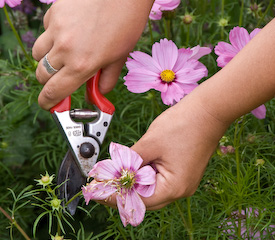
Although many flowers can be snapped off with your fingertips, it is often quicker to use snips.
With many flowers you can simply remove the old bloom with your finger tips. On plants with thicker stems it is wiser to use snips to prevent damaging the plants and new flowers.


Many perennials will grow new flowers and extend the flowering season when deadheaded.

The hardest part of this task is finding the time to do it.  If it's late in the season and your marigolds have more dead flowers than you want to deal with, take a chair and cup of tea to where they are and make the task more enjoyable. This will keep your marigolds blooming into early autumn.


On plants such as geraniums and marigold the old dead flowers turn brown and unsightly.
Deadheading keeps them looking neat and tidy.

Dead-heading is also beneficial to many other plants as well. Although most 'perennials' will only bloom for a few weeks during their season, removing the seeds encourages the plants to produce stronger root systems. Since many perennials are best propagated by division (dividing the root system) this practice is very beneficial.

Perennials also benefit from deadheading by producing new flowers
and extending its season.


Even plants grown for their leaves such as Hosta do best when old flowers are removed, producing stronger healthy root systems.


In order to propagate this daylily root division is the easiest and most dependable technique.
Deadheading the spent flowers encourages stronger root growth.
 Summer flowering shrubs such as butterfly bushes or roses will also produce more flowers when dead-headed.
Happy Gardening,
James

Monday, June 1, 2015

Butterfly Bush


BUTTERFLY BUSH
 

When planting remember a 'Buddleia' can rapidly out grow it's space.  
 
As the name implies, the butterfly bush 'Buddleia' is a shrub that attracts butterflies.  They seem to find this shrub impossible to pass by; Buddleia often host more than one butterfly at a time.  Also, don't be surprised to see a hummingbird visit the shrub, especially later in the season.
 

In midsummer, often more than one butterfly will visit this bush at a time. 

 
Noted for its long spires of flowers in a collection of tiny clusters, butterfly bushes bloom from midsummer until the frost period. Buddleia are available in a range of colors from white to pink, to purple, to blue, and even yellow. This hardy shrub dies back in winter and then re-sprouts from new growth next spring, flowering from 'new wood'.  To keep them neat and healthy give Buddleia a 'heavy' pruning every spring.  In late March or April prune it back to two or three feet from the ground. Amazingly it will still increase its height and width every year.  By forcing new growth from the bottom you encourage your shrub to sprout more new stems and many more
flowers.
 

Butterfly bushes are available in many colors, including yellow. 

 
A native to temperate regions of Asia, South Africa, and South America, this fast growing shrub can reach a height of over 6 ft and easily spread as wide in just a few years.  Although well worth the space, keep size in consideration when selecting a planting site.  This also means you can save money by planting a young plant and it will quickly reach its desired height.  Besides, Buddleia shrubs are both drought and deer resistant.  That is a plus for any plant.
 

 Yellow swallowtails, Monarchs and Black Swallowtails mingle with each other while
feeding at this beautiful flowering shrubs.

 
 Butterfly bushes have two draw backs.  First they can quickly outgrow their space. Once established they can grow and spread quickly.  Remember this when selecting a spot. Mature shrubs do not transplant well.  For those with less space there are now miniature varieties.  They will also attract butterflies. Secondly, butterfly bushes can self seed and spread where they are not wanted. I simply remove the unwanted plants treating them as weeds or pot them up to be replanted later.


New varieties of miniature butterfly bushes can easily find a spot in almost any garden
with enough sunlight.. 
 
 If butterflies love a flower so do bees. Remember that when planting Buddleia and keep them away from areas with a lot of human traffic and children. An ounce of prevention...
 

Even Hummingbirds visit for a quick snack. 
 
 
                                                                                                                                       Happy Gardening,

James


Monday, May 4, 2015

Earthworms in the Garden

       EARTHWORMS
         (Lumbricus terrestri)


Good garden soil should have ten earthworms per square foot.
The reddish-gray colored common earthworm, often called a night crawler in the United States, is familiar to anyone with a fishing rod or a garden. They are indigenous to Europe, but are now abundant in North America and western Asia.


Earthworms are vital to soil health because they transport nutrients and minerals from below the surface via their waste.  Their tunnels aerate the ground. An earthworm can eat up to one third its body weight in a day. A 'healthy' garden soil should have approximately ten earthworms per square foot.


Although not native to North America, earthworms are sign of healthy garden soil

Earthworms  burrow during the day, typically keeping close to the surface, but are capable of digging down as deep as 6.5 feet.


An earthworm can live six years in the wild.
Contrary to playground legend, if a worm is cut in half, two will not grow.  Therefore you are better off leaving your earthworm undisturbed to get the best results.  Amazingly earthworms can live up to six years in the wild.
Worm castings, also called ’vermicast', worm humus or worm manure, is the end-product of the breakdown of organic matter by an earthworm. These castings have been shown to contain reduced levels of contaminants and a higher saturation of nutrients than do organic materials before vermicomposting.


You can purchase worm castings or let your worms make it for you. 
To encourage as many earthworms in your garden as possible, add organic materials such as compost to your 
soil.  Scatter it on top or rake it in and the worms will do 
the rest.  This practice adds nutrients to your garden which 
is as good for your plants as it is for your worms. 


Earthworms help water move into the soil closer to the root systems of your plants. 

Most importantly limit the use of pesticides and insecticides as they can harm or kill your earthworms as well as your intended targets.


Although not the cutest critter on the planet, earthworms are worth their weight in gold. 
 The next time you dig up an earthworm while gardening
remember how essential they are and rather than just
tossing it to the side - cover it back up.  Earthworms 
wither and die quickly when left in the sun.


 Happy Gardening,
James
For more information on earthworms and other amazing creatures visit the National Geographic website